TL;DR:
- California provides strong protections against wrongful termination for healthcare workers reporting unsafe or illegal practices.
- Recognizing subtle retaliation signs and documenting early can strengthen your wrongful termination case.
- Seeking prompt legal advice and preserving records is crucial to effectively address wrongful termination claims.
Many healthcare workers in Azusa assume that California’s at-will employment rules leave them with little recourse when they lose their jobs. That assumption is wrong, and it costs people real money and real justice. California actually offers some of the strongest employee protections in the country, especially for workers who report unsafe conditions, face discrimination, or are pushed out through retaliation. Whether you work at a hospital, clinic, or long-term care facility, understanding your rights is the first step toward protecting them. This guide breaks down what qualifies as wrongful termination, which laws apply to you, and exactly what to do next.
Table of Contents
- What counts as wrongful termination in Azusa healthcare jobs
- Legal protections healthcare workers have against wrongful termination
- Recognizing subtle and complex forms of retaliation or constructive discharge
- What to do if you believe you were wrongfully terminated
- What most Azusa healthcare employees miss about wrongful termination
- Connect with experienced wrongful termination attorneys in Azusa
- Frequently asked questions
Key Takeaways
| Point | Details |
|---|---|
| More rights than expected | California healthcare workers are safeguarded against wrongful termination beyond just at-will rules. |
| Local laws matter | Azusa and LA County employees should know both state and unique local protections for healthcare jobs. |
| Retaliation takes many forms | Illegal firing can look like demotion, isolation, or forced resignation — especially after whistleblowing. |
| Act fast for best results | Timely action and documentation greatly improve your chances for a successful legal outcome. |
What Counts As Wrongful Termination in Azusa Healthcare Jobs
Let’s clear up the biggest misconception first. At-will employment means your employer can generally end your job for any reason or no reason at all. But “any reason” has firm legal limits. Firing someone for an illegal reason is wrongful termination, full stop.
In Azusa healthcare settings, wrongful termination typically falls into these categories:
- Discrimination: Being fired because of race, gender, age, disability, religion, national origin, or another protected characteristic under the California Fair Employment and Housing Act (FEHA)
- Retaliation: Losing your job after reporting patient safety violations, billing fraud, or unsafe working conditions
- Contract violations: Being let go in ways that breach a written or implied employment agreement
- Constructive discharge: Being forced to quit because your employer made conditions so intolerable you had no real choice
Here is a quick comparison of situations that are legal versus illegal:
| Situation | Legal? |
|---|---|
| Laid off due to budget cuts with no discriminatory pattern | Generally legal |
| Fired after reporting a Medicare billing violation | Illegal retaliation |
| Demoted after taking FMLA medical leave | Illegal retaliation |
| Terminated for poor performance with documented evidence | Generally legal |
| Forced to resign after being harassed for whistleblowing | Illegal constructive discharge |
Constructive discharge deserves special attention. Under California law, constructive discharge is treated the same as a direct firing when your employer’s conduct makes continued employment genuinely unbearable. As one legal analysis of California appellate decisions notes, constructive discharge is termination under CA law if conditions are intolerable due to retaliation or discrimination.
Public healthcare facilities in Los Angeles County carry additional obligations. Employees at county hospitals or publicly funded clinics have extra layers of protection under both civil service rules and constitutional due process rights.
“At-will employment does not mean your employer can fire you for any reason they want. It means they can fire you for any legal reason. That distinction changes everything.”
Familiarizing yourself with the relevant wrongful termination statutes in California is essential before you decide whether to take action.
Legal Protections Healthcare Workers Have Against Wrongful Termination
After understanding what qualifies as wrongful termination, it’s crucial to know the wide array of legal protections for healthcare employees. These protections come from multiple sources, and they stack on top of each other to give you real leverage.
Federal protections include:
- Title VII of the Civil Rights Act: Bars discrimination based on race, color, religion, sex, and national origin
- The Americans with Disabilities Act (ADA): Protects workers with disabilities and requires reasonable accommodations
- The Family and Medical Leave Act (FMLA): Gives eligible employees up to 12 weeks of protected leave per year
- The False Claims Act: Protects employees who report employer fraud against government healthcare programs like Medicare or Medi-Cal
California law goes further. FEHA covers employers with just five or more employees, compared to the federal threshold of 15. The California Family Rights Act (CFRA) expands on FMLA protections. And California Labor Code Section 1102.5 is one of the broadest whistleblower protection statutes in the nation.
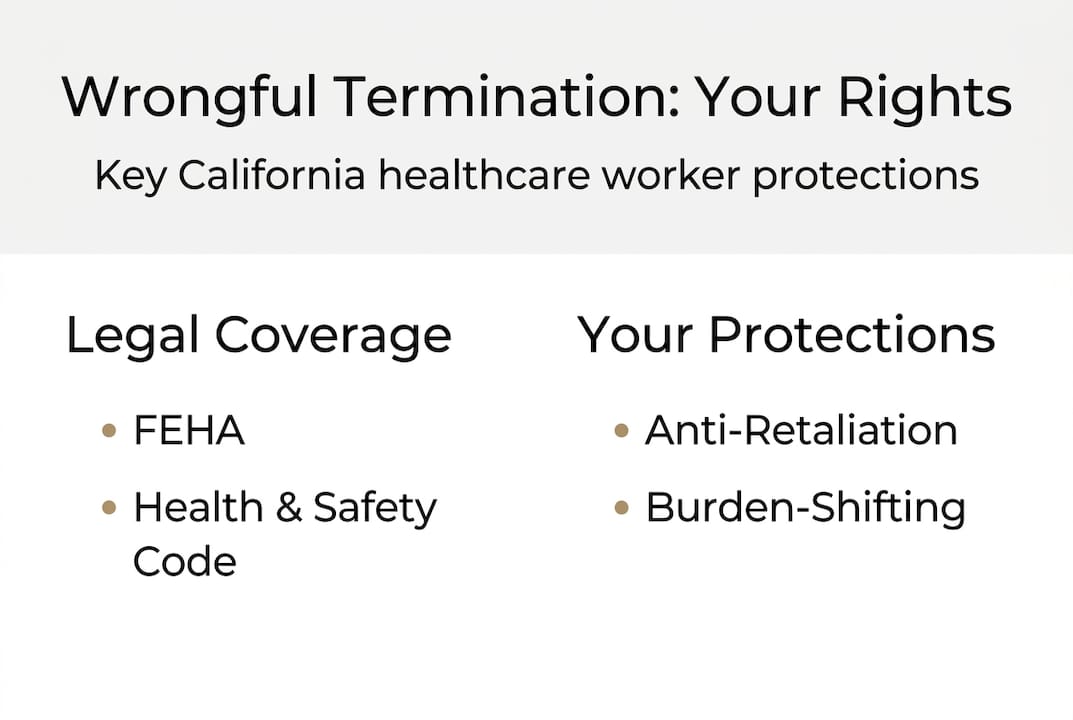
For employees at public healthcare facilities, Health & Safety Code §1278.5 grants specific anti-retaliation rights to employees who report patient care concerns or unsafe conditions.
One of the most significant recent developments in healthcare retaliation law is the burden-shifting standard. In most discrimination cases, the employee must prove the employer’s stated reason was a pretext. In whistleblower retaliation cases under Labor Code 1102.5, the employer must prove their reason was legitimate once you show protected activity contributed to the decision.
Pro Tip: If you work at a facility that receives any government funding, including Medicare or Medi-Cal reimbursements, you may have federal whistleblower protections in addition to California’s already strong state laws. That double layer matters enormously when building your case.
Connecting with workplace retaliation lawyers who know both state and federal law is the most reliable way to understand exactly which protections apply to your specific situation.
Recognizing Subtle and Complex Forms of Retaliation or Constructive Discharge
Legal protections only help if you recognize when wrongful termination is happening, even in hidden or subtle forms. Employers rarely announce that they are retaliating. Instead, the signs are gradual and easy to dismiss.
Watch for these red flags after you report a concern or exercise a legal right:
- Sudden negative performance reviews when your record was previously clean
- Schedule changes that make your job significantly harder or less desirable
- Being excluded from meetings, emails, or team communications you previously received
- Demotion or removal of responsibilities without a clear business reason
- Increased scrutiny or micromanagement that did not exist before
- Verbal warnings or written reprimands appearing out of nowhere
This pattern is sometimes called “papering the file.” Employers build a paper trail of negative documentation to justify a termination that is actually driven by illegal motives. It is a calculated move, and it works if you do not recognize it early.
Constructive discharge follows a similar logic. Your employer may not fire you directly. Instead, they make your working conditions so unbearable that you eventually resign. Under California law, recognizing constructive discharge early is critical because courts look at whether a reasonable person in your position would have felt compelled to quit.
The 2022 California Supreme Court ruling in Lawson v. PPG significantly strengthened whistleblower protections. Under the Lawson v. PPG standard, the burden shifts to the employer to prove their reason was legitimate once an employee shows that protected whistleblower activity contributed to the adverse action. That is a major shift from the traditional burden on employees.
Pro Tip: Start a private written log the moment you notice any of these red flags. Record dates, times, what was said or done, and who was present. This documentation can become the backbone of your legal case.
If you are in the San Gabriel Valley area, San Dimas retaliation lawyers familiar with local healthcare employers can help you assess whether what you are experiencing crosses the legal line.
What To Do if You Believe You Were Wrongfully Terminated
Once you recognize your rights have been violated, here’s exactly how to take action. Moving quickly and methodically makes the difference between a strong case and a missed opportunity.
Step-by-step action plan:
- Secure your records immediately. Save copies of performance reviews, emails, schedules, and any communications related to your termination. Do this before you lose access to employer systems.
- Request your personnel file. California law gives you the right to review and copy your personnel records. Submit a written request as soon as possible.
- Write a detailed timeline. Document every relevant event in chronological order, including dates, names, and what was said or done.
- Identify witnesses. Think about coworkers who observed the retaliation, discrimination, or hostile conditions. Their accounts may support your claim.
- File a complaint with the right agency. Depending on your situation, you may file with the Equal Employment Opportunity Commission (EEOC), the California Civil Rights Department (formerly DFEH), or your facility’s HR department.
- Consult an employment attorney. Many wrongful termination attorneys work on contingency, meaning you pay nothing unless you win.
Deadlines are one of the most common places people lose their cases. For FEHA claims, you generally have three years from the discriminatory act to file with the California Civil Rights Department. Some federal claims carry shorter windows. Missing these deadlines can permanently bar your claim.
As experienced local attorneys emphasize, law firms with experience in healthcare whistleblower and wrongful termination cases should be prioritized when choosing representation.
Pro Tip: Do not post about your termination on social media. Anything you write publicly can be used against you in litigation. Keep your case details private until you have spoken with an attorney.
An Azusa wrongful termination lawyer who knows the local healthcare landscape can assess your case quickly and help you avoid costly mistakes. If your situation involves retaliation at a facility in the broader Inland Empire region, Ontario retaliation lawyers can also provide targeted guidance.
What Most Azusa Healthcare Employees Miss About Wrongful Termination
After working with employees across Southern California, one pattern stands out clearly. The workers who protect themselves best are not necessarily the ones with the strongest cases at the moment of termination. They are the ones who started documenting early, understood their rights before a crisis hit, and reached out to local counsel quickly.
Many employees wait. They fear retaliation for filing a complaint, or they convince themselves that “at-will” means they have no case. Both of those hesitations cost people real leverage. The strongest wrongful termination cases are often built before the termination happens, through consistent records and a clear pattern of employer misconduct.
National firms can handle employment cases, but local attorneys who know Azusa employers, local courts, and the specific culture of healthcare facilities in LA County often produce better outcomes. Familiarity with the specific employer matters more than people realize. Reviewing what a dedicated Azusa wrongful termination perspective looks like in practice can help you understand what to expect from the process.
Connect With Experienced Wrongful Termination Attorneys in Azusa
Ready to protect your rights? Here’s where local Azusa healthcare workers can get the help they need. At Huprich Law, we focus exclusively on employee rights, and we know how to fight for healthcare workers facing wrongful termination, retaliation, and discrimination. We handle a full range of employment law cases across Southern California, including complex whistleblower and healthcare retaliation claims. If you believe you have been wrongfully terminated or pushed out, do not wait. Get the answers you deserve with a free consultation. Visit our Azusa wrongful termination help page or contact Huprich Law today to speak with an attorney who will fight tooth and nail for your rights.
Frequently Asked Questions
Can I Be Fired for Reporting Unsafe Conditions at My Azusa Hospital?
No, California law protects healthcare workers from retaliation for reporting unsafe or illegal practices. Health & Safety Code §1278.5 specifically bars retaliation at public healthcare facilities.
What Is Constructive Discharge and How Does It Apply to Healthcare Workers?
Constructive discharge means you were forced to quit due to intolerable work conditions, and California law treats it as wrongful termination. If employer conduct makes work intolerable through retaliation or discrimination, you may have a valid claim even if you resigned.
Do I Need a Lawyer if I Suspect Retaliation After Blowing the Whistle?
Yes, experienced attorneys can help you prove your case and maximize your protections under California’s strong whistleblower laws. After Lawson v. PPG shifts the burden to employers, having skilled legal counsel ensures that shift works in your favor.
How Long Do I Have To File a Wrongful Termination Claim in California Healthcare?
The timeline can be as short as 180 days for some federal claims, so act quickly and consult legal counsel to confirm your specific deadlines before you lose the right to file.
Recommended
- Top Azusa California Wrongful Termination Lawyer
- Top Azusa Disability Accommodation Lawyer
- Top San Dimas Wrongful Termination Lawyer
- Top East Los Angeles Wrongful Termination Lawyer
- Labor Law Audit Services | Compliance Experts Nestlers