Retaliation in the workplace in Azusa, CA, is illegal under California law when an employer punishes an employee for speaking up about misconduct, discrimination, or unsafe conditions. California Labor Code Section 1102.5, the Fair Employment and Housing Act (FEHA), and Labor Code Section 98.6 all prohibit this conduct. The California Civil Rights Department (CRD) and the Labor Commissioner enforce these protections. If your employer fired you, demoted you, or made your job miserable after you reported a problem, you have legal options worth understanding right now.
What Activities Are Protected Under Retaliation Laws in Azusa, CA Workplaces?
California law protects a broad range of employee actions. Many workers in Azusa assume they are only covered if they reported wrongdoing to a government agency. That assumption is wrong and costly.
Internal reports made to a supervisor, HR department, or company compliance officer trigger full whistleblower protections under Labor Code 1102.5. You do not need to contact an outside agency to be protected. This is one of the most misunderstood aspects of California workplace retaliation laws.
Protected activities include:
- Reporting violations of state or federal law to a supervisor, HR, or a government agency
- Refusing to participate in activities you reasonably believe are illegal
- Opposing discrimination or harassment based on race, gender, disability, age, or other protected characteristics under FEHA
- Participating in a workplace investigation, administrative hearing, or court proceeding
- Filing a wage claim or reporting unpaid wages to the Labor Commissioner
- Reporting unsafe work conditions to Cal/OSHA or internally to management
- Requesting a reasonable accommodation for a disability or religious belief
A critical protection that surprises many employees: good-faith belief is all you need. California Labor Code 1102.5 protects you even if the violation you reported turns out not to have occurred, as long as you genuinely and reasonably believed it did. You are not required to be right. You are required to be honest.
Pro Tip: Write down exactly what you reported, to whom, and when. Do this the same day you make any complaint. That record becomes your foundation if retaliation follows.
What Types of Employer Actions Count As Illegal Retaliation?
Illegal retaliation is not limited to getting fired. California law covers any materially adverse action that would deter a reasonable employee from speaking up. That standard is broader than most workers realize.
Adverse actions recognized under California law include:
- Termination or constructive discharge (forcing you to quit through intolerable conditions)
- Demotion or reduction in job title or responsibilities
- Pay cuts or denial of a raise or promotion you were otherwise due
- Negative performance reviews that do not reflect your actual work
- Schedule changes designed to inconvenience or punish you
- Exclusion from meetings, training, or opportunities available to colleagues
- Increased scrutiny or micromanagement that began after your complaint
- Creation of a hostile work environment through harassment or isolation
Subtle retaliation is still retaliation. An employer who starts scheduling you for undesirable shifts the week after you filed a harassment complaint is engaging in conduct California courts take seriously.
The 2024 amendment known as SB 497 added a powerful tool for employees. Under this law, if an adverse action occurs within 90 days of a protected activity, a rebuttable presumption of retaliation arises automatically. That means the employer must prove the action was not retaliatory. The burden shifts to them, not you. That 90-day window is one of the strongest protections California has added to its retaliation framework in years.

How Do Employees Prove Retaliation and What Is the Employer’s Burden?
Proving retaliation requires establishing three elements. Understanding them helps you build your case from day one.
- Protected activity. You engaged in a legally protected act, such as reporting a wage violation, opposing harassment, or refusing an illegal order.
- Adverse action. Your employer took a negative employment action against you.
- Causal connection. A link exists between your protected activity and the adverse action taken against you.
Once you establish that your protected activity was a contributing factor in the adverse action, the burden shifts to your employer. They must then show, with clear evidence, that the same action would have occurred regardless of your complaint. That is a high bar for employers to clear, especially when the timing is close.
Close timing between your complaint and the adverse action is strong circumstantial evidence. Courts and agencies treat it seriously. An employee who receives a glowing review in March and a termination notice two weeks after filing a discrimination complaint in april has a compelling timeline to present.
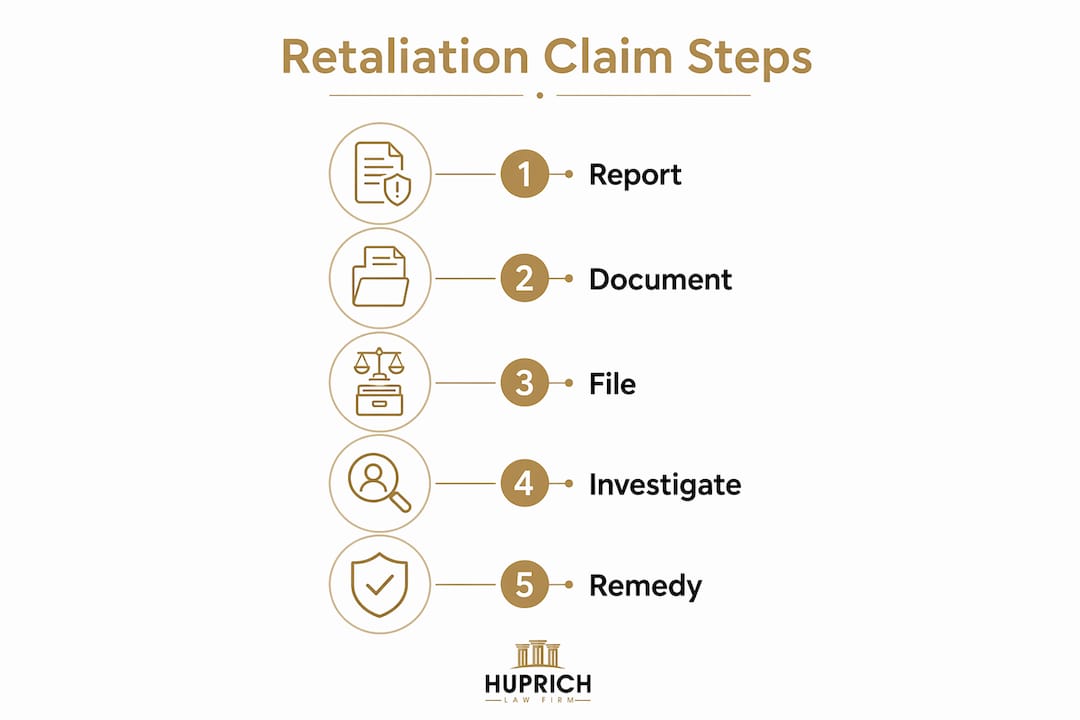
Documenting complaints and adverse actions immediately is the single most important thing you can do. Save emails. Screenshot messages. Keep a dated journal of conversations. A common and damaging mistake employees make is waiting weeks or months before writing anything down, which weakens the evidentiary record significantly.
Pro Tip: Send a follow-up email to HR after any verbal complaint. Write something like “I wanted to confirm our conversation today regarding…” This creates a written record with a timestamp that is hard to dispute later.
If you need guidance on the formal process, the retaliation claim process in California has specific steps that protect your rights at each stage.
What Are the Filing Options, Deadlines, and Processes for Retaliation Claims in Azusa, CA?
Filing with the right agency by the right deadline is non-negotiable. Missing a deadline can permanently bar your claim, regardless of how strong it is.
Different agencies handle different types of retaliation claims, each with its own deadline:
| Agency | Type of Claim | Deadline |
|---|---|---|
| California Civil Rights Department (CRD) | Discrimination and harassment retaliation under FEHA | 3 years from the retaliatory act |
| California Labor Commissioner | Wage-related retaliation under Labor Code 98.6 | 3 years from the retaliatory act |
| Cal/OSHA | Workplace safety retaliation | 6 months from the retaliatory act |
| Private civil lawsuit | After CRD right-to-sue letter | 1 year from CRD right-to-sue letter |
The filing deadlines range from 6 months for safety-related complaints to 3 years for most other retaliation claims. The 6-month Cal/OSHA deadline is the one that catches employees off guard most often. If you reported a safety violation and faced retaliation, act fast.
Key steps to protect your claim:
- File your complaint as soon as possible after the retaliatory act
- Gather and preserve all written communications, performance records, and witness contact information
- Request your personnel file from your employer, which is your legal right in California
- Consult with an employment attorney before filing to choose the right agency and strategy
For discrimination-related retaliation claims, you may also file a private lawsuit after receiving a right-to-sue letter from the CRD. This opens the door to a broader range of damages, including emotional distress and punitive damages, that agency proceedings alone may not provide.
What Remedies Can Employees Expect if a Retaliation Claim Succeeds?
A successful retaliation claim in California carries real financial and professional consequences for employers. Knowing what you can recover helps you assess whether pursuing a claim is worth your time and energy. It almost always is.
California law provides remedies including reinstatement to your former position, back pay for lost wages, and front pay if reinstatement is not practical. Under FEHA, you can also recover compensation for emotional distress and, in cases of egregious employer conduct, punitive damages. Civil penalties of up to $10,000 per employee per violation apply under the Labor Code. That penalty structure exists to deter employers from treating retaliation as a cost of doing business.
Additional remedies available to Azusa employees include:
- Removal of negative performance reviews or disciplinary records from your personnel file
- Recovery of attorney fees and litigation costs
- Injunctive relief requiring the employer to change policies or practices
- Reinstatement of benefits, seniority, and other employment terms
If you experienced discrimination-related retaliation, an attorney familiar with discrimination claims in California can help you assess the full scope of damages available under both FEHA and federal law.
Key Takeaways
California’s retaliation protections are among the strongest in the country, and Azusa employees who speak up about misconduct have multiple legal avenues to fight back and recover meaningful compensation.
| Point | Details |
|---|---|
| Protected activity is broad | Reporting violations internally to HR or a supervisor is fully protected under Labor Code 1102.5. |
| SB 497 shifts the burden | Adverse action within 90 days of a complaint creates a presumption of retaliation the employer must disprove. |
| Document everything immediately | A dated written record of complaints and adverse actions is your strongest evidence in any retaliation case. |
| Deadlines vary by agency | Safety retaliation claims must be filed with Cal/OSHA within 6 months; most others allow up to 3 years. |
| Remedies are substantial | Successful claims can recover back pay, emotional distress damages, and civil penalties up to $10,000 per violation. |
What I Have Learned From Retaliation Cases in Azusa
I have represented employees across the San Gabriel Valley, including workers in Azusa, Baldwin Park, and El Monte, who came to me after staying silent for too long. The pattern is almost always the same. They noticed the retaliation, felt unsure whether it “counted,” and waited. By the time they called, evidence had faded, witnesses had moved on, and deadlines were dangerously close.
The biggest misconception I encounter is that employees believe they need a smoking gun. They think they need a text message where the boss says, “I’m firing you because you complained.” Courts do not require that. Circumstantial evidence, especially close timing, is powerful. The SB 497 presumption exists precisely because legislators recognized that employers rarely announce their retaliatory intent.
My honest advice: do not wait to see if things get better. Retaliation rarely stops on its own. The moment you suspect your employer is punishing you for speaking up, start documenting and start talking to an attorney. A free consultation costs you nothing. Waiting can cost you everything.
You have the right to speak up at work without fear. California law backs that right with real teeth. Use it.
— Joseph Huprich
How Huprich Law Firm Helps Azusa Employees Fight Back
Huprich Law Firm focuses exclusively on employee rights across Southern California, including Azusa and the surrounding San Gabriel Valley. If you believe your employer retaliated against you for reporting misconduct, requesting accommodations, or opposing discrimination, the firm offers a free, confidential case review to assess your options. Huprich Law Firm works on contingency, meaning you pay nothing unless you win. Every case receives personal attention, not a one-size-fits-all approach. Reach out to a California employment lawyer at Huprich Law Firm today to protect your rights before a filing deadline passes.
FAQ
What is workplace retaliation under California law?
Workplace retaliation occurs when an employer takes an adverse employment action against an employee for engaging in a legally protected activity, such as reporting misconduct or opposing discrimination. California Labor Code 1102.5 and FEHA both prohibit this conduct.
Do I have to report to a government agency to be protected?
No. Internal reports to a supervisor, HR, or a compliance officer trigger full whistleblower protections under California Labor Code 1102.5. Reporting to an outside agency is not required.
How long do I have to file a retaliation claim in Azusa, CA?
Deadlines depend on the type of claim. Safety-related retaliation must be reported to Cal/OSHA within 6 months. Most other retaliation claims have a 3-year deadline with the CRD or Labor Commissioner.
What if my employer claims they had a legitimate reason for the adverse action?
Once you show your protected activity was a contributing factor, the employer must prove the same action would have happened regardless of your complaint. Under SB 497, adverse action within 90 days of your complaint creates a presumption of retaliation they must overcome.
What can I recover if my retaliation claim succeeds?
You may recover reinstatement, back pay, front pay, emotional distress damages, attorney fees, and civil penalties up to $10,000 per violation under the California Labor Code.