If you work in Chino and your employer has shorted you on overtime or withheld wages, California law gives you real, enforceable rights to get that money back. California Labor Code § 510 sets the standard: any non-exempt employee earns 1.5 times their regular pay for hours beyond 8 in a workday or 40 in a workweek, and double time for hours beyond 12 in a single day. Wage theft, including unpaid wages and overtime, is not a gray area. It is illegal, and the law is firmly on your side.
Employees in Chino and throughout San Bernardino County have multiple paths to recover what they are owed:
- File a wage claim with the California Division of Labor Standards Enforcement (DLSE), also called the Labor Commissioner’s Office
- Pursue a civil lawsuit directly against your employer in court
- File a PAGA claim under the Private Attorneys General Act to seek civil penalties for employer-wide violations
- Consult an employment attorney who handles California wage and overtime cases on a contingency fee basis
California law also protects you from retaliation. Your employer cannot legally fire you, demote you, or threaten you for asserting your right to fair pay. If that happens, you have a separate retaliation claim on top of your wage claim. The statute of limitations for most unpaid wage violations is three years from the date of the most recent violation, so acting promptly protects your ability to recover the full amount owed.
How California Overtime And Wage Laws Apply To Chino Employees
California’s wage protections are among the strongest in the country, and they apply to virtually every worker in Chino regardless of immigration status. Understanding exactly how the rules work puts you in a far stronger position if a dispute arises.
Daily and weekly overtime thresholds
Under Labor Code § 510, overtime in California is calculated on both a daily and a weekly basis. That daily calculation is what sets California apart from most other states.
- Over 8 hours in a workday: 1.5 times your regular rate of pay
- Over 12 hours in a workday: 2 times your regular rate of pay
- First 8 hours on the 7th consecutive workday: 1.5 times your regular rate
- Over 8 hours on the 7th consecutive workday: 2 times your regular rate
- Over 40 hours in a workweek: 1.5 times your regular rate
Your employer must pay whichever calculation results in the higher amount. They cannot average hours across the week to avoid paying daily overtime.
Exempt vs. non-exempt status
Not every employee automatically qualifies for overtime. California law recognizes exemptions for certain executive, administrative, and professional employees, but the bar is high. Being salaried does not automatically exempt you from overtime. To qualify as exempt, you must meet both a duties test and a salary threshold. If your employer labeled you “exempt” without genuinely meeting those criteria, you may have a valid unpaid overtime claim.
Meal and rest break obligations
California law requires most non-exempt workers to receive an uninterrupted 30-minute unpaid meal period for every 5 hours worked, and a paid 10-minute rest period for every 4 hours worked. If your employer fails to provide either, you are entitled to one additional hour of pay at your regular rate for each missed break. Those premium wages are separate from your overtime claim and can add up quickly over months or years of violations.
Employer recordkeeping duties
By law, your employer must maintain accurate time and payroll records and provide you with an itemized wage statement every pay period. That statement must include your name, hours worked, pay rates, the pay period dates, and all deductions. When employers fail to keep accurate records, the DLSE can still investigate your claim based on your own documentation.
Common Wage And Overtime Violations Chino Workers Face
Wage theft takes many forms, and some of the most common violations are ones workers do not immediately recognize as illegal. Chino’s mix of warehousing, manufacturing, retail, and service-sector employers creates conditions where certain abuses tend to repeat.
- Unpaid overtime: Employers require or allow employees to work beyond 8 hours a day without paying the required premium rate. This is especially common in warehouse and distribution jobs throughout the Inland Empire.
- Misclassification as exempt or independent contractor: Labeling a worker as a salaried “manager” or an independent contractor to avoid overtime obligations is one of the most widespread violations in California. The DLSE’s overtime FAQ makes clear that job title alone does not determine exempt status.
- Missed meal and rest breaks: Employees are pressured to skip breaks or work through them without receiving the one-hour premium wage they are owed.
- Illegal paycheck deductions: Employers deduct costs for uniforms, tools, or cash register shortages from employee wages, which California law generally prohibits.
- Inaccurate or missing wage statements: Pay stubs that omit hours worked, pay rates, or employer contact information violate California Labor Code § 226 and can support a separate penalty claim.
- Withheld final paychecks: If your employer fires you, your final paycheck is due on your last day. If you resign with 72 hours’ notice, it is due on your last day. Willful failure to pay triggers waiting time penalties of up to 30 days’ wages.
- Unreimbursed business expenses: If you use your personal vehicle for work or purchase supplies your employer requires, you are entitled to reimbursement.
- Off-the-clock work: Requiring employees to clock out and then continue working, attend pre-shift meetings, or complete closing duties without pay is wage theft, full stop.
Retaliation is a real concern for Chino workers who speak up. Employers sometimes cut hours, reassign shifts, or manufacture reasons to terminate employees who raise wage complaints. California law prohibits all of it, and retaliation itself creates an additional legal claim.

How To Protect Your Rights And Recover Unpaid Wages In Chino
Taking action on a wage claim does not have to feel overwhelming. The process has clear steps, and California law gives you more than one route to recovery.
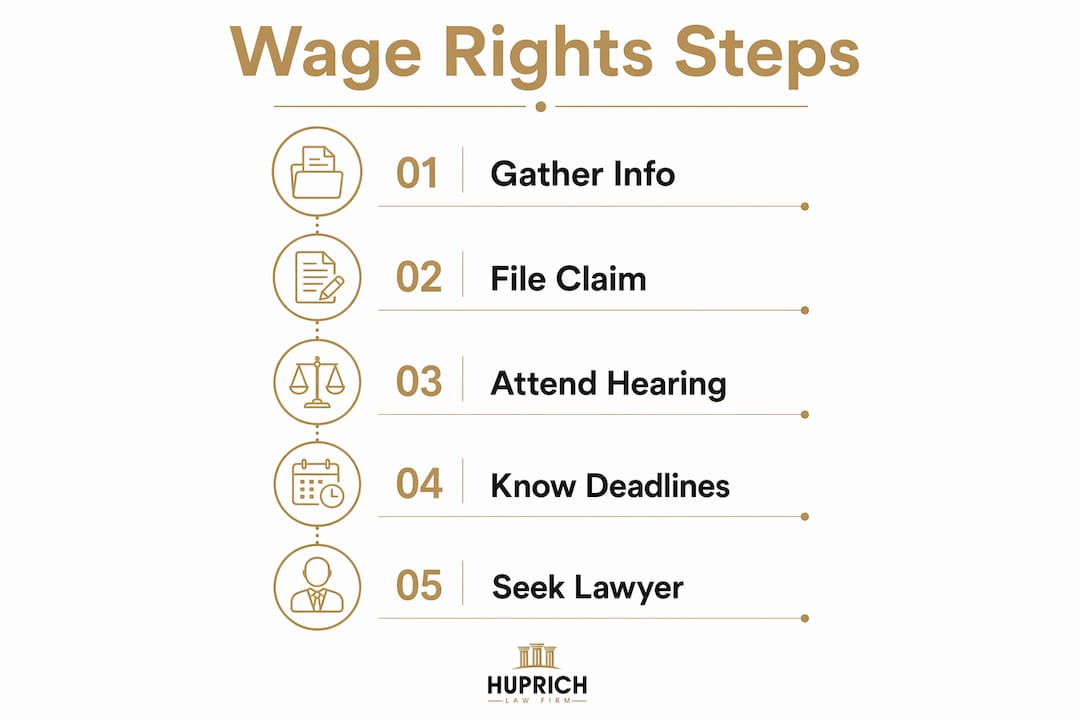
Step 1: Gather your documentation
Before you file anything, collect every piece of evidence you can find.
- Personal time logs, notes, or calendar entries showing hours worked
- Copies of all pay stubs and paychecks from the claim period
- Any written communications from your employer about your schedule, pay rate, or hours
- Your employment offer letter or any written contract
- Copies of bounced checks, if applicable
Employer recordkeeping is required by law, but employers sometimes produce inaccurate records to deny claims. Your own contemporaneous notes carry real weight at a hearing.
Step 2: File a wage claim with the DLSE

You can file a wage claim with the California Labor Commissioner’s Office online, by mail, or in person. Complete DLSE Form 1 (“Initial Report or Claim”). If your hours varied week to week, also complete DLSE Form 55. Submit copies of your supporting documents with the form. Do not send originals.
After you file, a Deputy Labor Commissioner reviews the claim and typically schedules a settlement conference within 30 days. If the conference does not resolve the dispute, a formal hearing is scheduled. Hearings are informal but legally binding, and you bear the burden of proof, so preparation matters.
Step 3: Know your time limits
The statute of limitations for most wage and overtime violations in California is three years from the date of the most recent violation. For claims based on a written contract, you have four years. For oral wage promises above minimum wage, you have two years. Missing these deadlines means losing your right to recover, regardless of how strong your underlying claim is.
Step 4: Consider a PAGA claim
The Private Attorneys General Act allows you to act as a representative of the state and pursue civil penalties against your employer for Labor Code violations that affected other employees, not just yourself. PAGA claims are separate from individual wage recovery and can be combined with a civil lawsuit. They are particularly powerful when an employer has engaged in a pattern of violations across a workforce.
Step 5: Consult an employment attorney
An experienced California employment attorney can assess your claim, identify violations you may have missed, and handle the legal process on your behalf. Huprich Law Firm works on a contingency fee basis, meaning you pay nothing unless you recover. That arrangement levels the playing field against employers who have legal teams on retainer.
Pro Tip: Keep a running log of your hours in a personal notebook or phone app, separate from any employer system. If your employer’s records are disputed at a hearing, your own consistent, dated entries can tip the scales in your favor.
- Collect all pay stubs, time records, and written communications
- File DLSE Form 1 (and Form 55 if hours varied) with supporting copies
- Attend the settlement conference prepared to discuss your timeline
- If unresolved, proceed to the formal hearing with organized evidence
- Explore PAGA claims if violations affected coworkers as well
- Consult a California employment attorney before or during any step
What Huprich Law Firm Brings To Wage Claims In Southern California
Huprich Law Firm has built its practice around one focus: fighting for employees in Southern California who have been shortchanged by their employers. That focus extends across the Inland Empire, including Chino and the broader San Bernardino County area, where wage and overtime disputes arise in warehouses, retail operations, restaurants, and construction sites every day.
What sets this firm apart for Chino employees
- Contingency fee representation: You pay nothing upfront. Huprich Law Firm only collects a fee if you win or settle your case.
- Free consultations: You can discuss your situation with an attorney at no cost before committing to anything.
- Deep knowledge of California wage law: The firm handles unpaid wages and overtime claims under the California Labor Code, PAGA, and related statutes.
- Local context: Understanding the specific industries and employer practices common to Chino and San Bernardino County shapes how the firm approaches each case.
- Early action matters: Because the three-year statute of limitations runs from the most recent violation, waiting costs you money. The sooner you consult an attorney, the more of your claim you can protect.
Misclassification cases are a particular area of strength. Employers across the Inland Empire frequently label workers as exempt managers or independent contractors to sidestep overtime obligations. Huprich Law Firm knows how to challenge those classifications and recover the overtime pay workers should have received all along. You can learn more about employee misclassification rights and what California law says about your situation.
Pro Tip: If you are unsure whether your employer has misclassified you, write down your actual daily duties in detail. Courts and the DLSE look at what you actually do, not what your job title says.
If you are ready to talk through your situation, schedule a free consultation with Huprich Law Firm. There is no obligation, and the conversation itself may clarify exactly what you are owed.
Key Takeaways
California employees in Chino have enforceable rights to overtime pay, accurate wage statements, and timely final paychecks under the California Labor Code, with a three-year window to file most claims.
| Point | Details |
|---|---|
| Daily overtime threshold | California requires 1.5x pay after 8 hours in a workday and 2x pay after 12 hours, under Labor Code § 510. |
| Statute of limitations | Most unpaid wage and overtime claims must be filed within three years of the most recent violation. |
| Exempt status is not automatic | Being salaried does not exempt you from overtime; both a duties test and a salary threshold must be met. |
| Final paycheck penalties | Willful withholding of a final paycheck can trigger waiting time penalties of up to 30 days’ wages. |
| PAGA expands your options | A PAGA claim lets you pursue civil penalties for employer-wide violations, separate from your individual wage recovery. |