
If you were recently let go from your job and something feels off about how it happened, you are not alone in wondering whether what occurred was actually legal. Wrongful termination is one of the most misunderstood areas of employment law, especially in California. Many employees assume that because California is an at-will employment state, their employer had the right to fire them for any reason. That is simply not true. Understanding what is wrongful termination, how it differs from an unfair firing, and what you can do about it could change the outcome of your situation entirely.
Table of Contents
- Key takeaways
- What is wrongful termination under California law
- Real examples of wrongful termination in California
- How to identify if your termination may be wrongful
- Legal remedies and what you can recover
- My perspective on wrongful termination claims
- Talk to Huprichlaw about your wrongful termination case
- FAQ
Key takeaways
| Point | Details |
|---|---|
| At-will has real limits | Even in California, employers cannot fire you for illegal reasons like discrimination or retaliation. |
| FEHA protects broad categories | California’s Fair Employment and Housing Act covers race, gender, disability, age, religion, and more. |
| Constructive termination counts | Being forced to quit due to intolerable conditions can qualify as wrongful termination under California law. |
| Evidence and timing matter most | A close timeline between a complaint and your firing significantly strengthens a retaliation claim. |
| Act before deadlines expire | Filing windows with the DFEH and EEOC are strict, so consulting an attorney early protects your rights. |
What is wrongful termination under California law
Wrongful termination means being fired for an illegal reason, not simply being treated unfairly or dismissed without cause. This distinction matters enormously. Your employer may have had every legal right to let you go for poor performance or budget cuts. But if the real motive behind your firing was your race, a disability accommodation request, or the fact that you reported wage theft, that changes everything.
California Labor Code §2922 codifies at-will employment but makes clear that statutory exceptions exist to protect employees. Those exceptions cover a wide range of situations.
The main legal grounds for wrongful termination in California include:
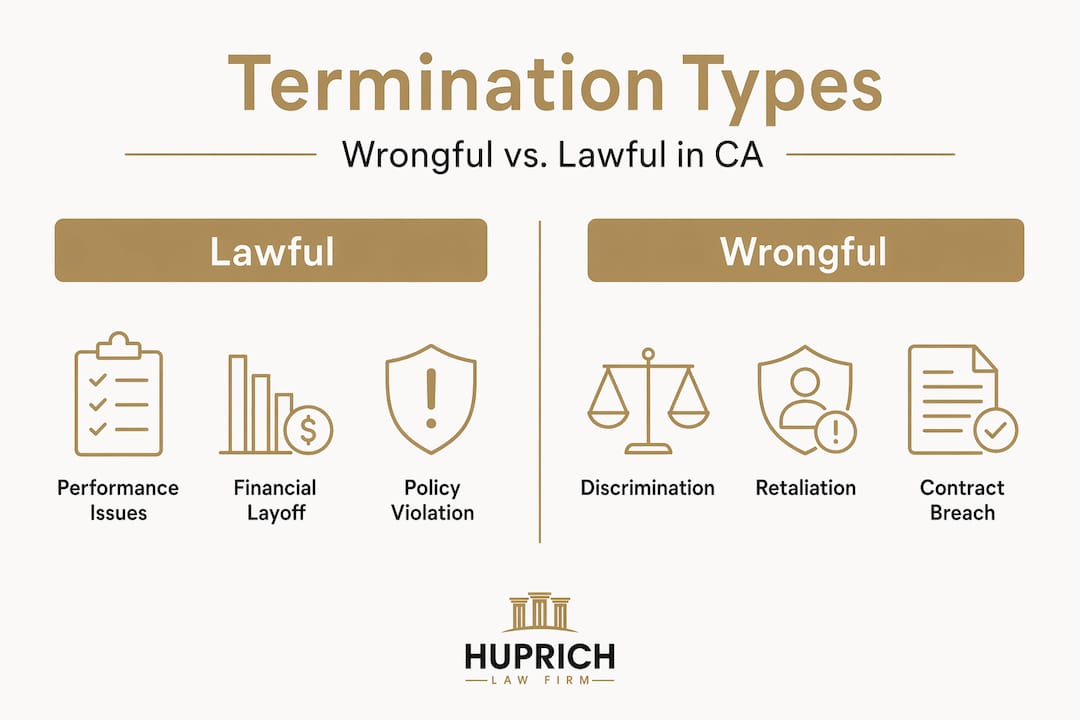
- Discrimination: Firing based on a protected characteristic under the Fair Employment and Housing Act (FEHA), including race, national origin, sex, gender identity, age (40 and over), disability, religion, pregnancy, or sexual orientation.
- Retaliation: Terminating an employee for engaging in a protected activity, such as reporting workplace harassment, filing a wage claim, or complaining about unsafe working conditions.
- Whistleblower protections: Firing an employee for reporting safety violations or refusing to participate in illegal activity.
- Contract breach: Violating an express written contract or an implied contract created by an employee handbook or verbal assurances about job security.
- Public policy violations: Firing someone for exercising a legal right, like taking protected family or medical leave, serving on jury duty, or voting.
Pro Tip: If your employer has a written termination policy in the employee handbook and failed to follow it before firing you, that procedural failure can support a wrongful termination claim.
The wrongful termination definition under California law is not about whether the firing felt unjust. It is about whether the motive was unlawful. That framing is what separates a legal claim from a bad workplace experience.
Real examples of wrongful termination in California
Understanding abstract legal concepts is one thing. Seeing how they play out in real workplaces around Ontario, Pomona, and the broader Inland Empire is another. Here are some of the most common scenarios that California employment attorneys see.
Termination after a harassment complaint. An employee reports that a supervisor has been making inappropriate comments. Two weeks later, the employee is fired for “poor attitude.” The close timing between the complaint and the termination is a textbook retaliation pattern and often qualifies as wrongful termination.
Firing after a disability accommodation request. A warehouse worker in Ontario requests a temporary light-duty assignment after a back injury. The employer denies the request and terminates the worker the following week. Under FEHA, employers must engage in a good-faith interactive process before denying accommodations.
Whistleblower retaliation. An employee at a logistics company in Pomona reports that the company is falsifying safety inspection records. Within a month, the employee is laid off in what the company calls a “restructuring.” California’s whistleblower retaliation protections are among the strongest in the country, and this scenario often supports a strong legal claim.
Constructive termination. Not all wrongful termination cases involve an explicit firing. Constructive termination occurs when an employer deliberately creates working conditions so intolerable that a reasonable person would feel forced to resign. California courts recognize this as a valid wrongful termination claim.
Termination during protected leave. An employee takes approved family leave under the California Family Rights Act (CFRA) and returns to find their position eliminated. If the elimination was pretextual and timed to the leave, it may constitute wrongful termination based on a public policy violation.
Pro Tip: Document everything. Save emails, texts, and performance reviews before and after any complaint or protected activity. Evidence gathered early gives your attorney far more to work with.
Not every firing is wrongful. A layoff driven by genuine financial need, a termination for consistent rule violations, or a decision made before any protected activity occurred are generally lawful. The distinction often comes down to the employer’s motive and whether the stated reason holds up under scrutiny.

How to identify if your termination may be wrongful
Evaluating your own situation requires some honest reflection and careful documentation. Here is a practical framework to get started.
- Compare the stated reason to the timeline. Did the termination come shortly after you filed a complaint, requested leave, or reported misconduct? Timing between complaint and termination is one of the strongest indicators of a retaliatory motive.
- Ask whether the reason makes sense. If you had strong performance reviews for years and were suddenly fired for “performance issues” right after reporting something, that inconsistency matters.
- Gather communications. Collect emails, texts, voicemails, and written warnings. Save any documentation of your complaint or protected activity. Store these securely outside of company systems before your access is revoked.
- Identify witnesses. Coworkers who witnessed the events, heard relevant conversations, or were treated differently under similar circumstances can be valuable.
- Review your employment agreement and handbook. Look for language about termination procedures, progressive discipline, or job security. Employers who fail to follow their own stated policies can contribute to wrongful termination claims.
The table below can help you think through whether your situation may involve what constitutes wrongful termination.
| Situation | Likely lawful | Potentially wrongful |
|---|---|---|
| Fired for documented poor performance with prior warnings | Yes, if no illegal motive | No, unless pretextual |
| Fired after reporting workplace harassment | Unlikely | Yes, strong retaliation indicator |
| Laid off during company-wide restructuring | Typically yes | Not if targeted at protected status |
| Forced to quit due to hostile work environment | No | Yes, constructive termination claim |
| Fired during or after protected medical leave | No | Yes, likely public policy violation |
Once you have a clearer picture, consult with an employment attorney who knows California law. A free consultation can help you decide whether pursuing a claim makes sense.
Legal remedies and what you can recover
California employees who experience wrongful termination are not without options. Understanding the legal remedies available helps you see why proper claim classification is critical to the outcome.
The typical path forward involves one or more of the following steps:
- File with the Civil Rights Department (CRD). Formerly known as the DFEH, California’s Civil Rights Department handles discrimination and retaliation complaints. For most FEHA claims, you must file with the CRD before suing in court.
- File with the EEOC. If your claim involves federal law (such as Title VII or the ADA), you may also need to file with the Equal Employment Opportunity Commission. California employees typically have 300 days from the discriminatory act to file.
- Pursue a civil lawsuit. After receiving a right-to-sue notice, you can file a lawsuit in California state or federal court depending on the legal theories involved.
Wrongful termination rights in California can translate to meaningful financial recovery. Possible remedies include:
| Remedy | What it means for you |
|---|---|
| Back pay | Wages and benefits lost from the date of termination |
| Front pay | Compensation for future lost earnings if reinstatement is not practical |
| Reinstatement | Return to your former position in some cases |
| Emotional distress damages | Compensation for psychological harm caused by the wrongful firing |
| Punitive damages | Available in cases of egregious employer misconduct |
| Attorney’s fees | Many California employment statutes allow fee-shifting to the employer |
Most wrongful termination cases in California settle before trial, but having a skilled attorney positions you to negotiate from strength. Early legal consultation often makes the difference between a weak settlement and a result that genuinely reflects what you lost.
My perspective on wrongful termination claims
In my experience representing employees across the Inland Empire and beyond, the cases that succeed share one thing in common: the employee paid attention to the details before they even came to me.
I have seen good claims fall apart because a client waited too long to preserve key emails, or because they said something in a separation agreement that limited their options. I have also seen cases that looked weak on the surface turn into powerful claims once we laid out the timeline and showed the pattern of employer behavior.
What many employees do not realize is that is wrongful termination illegal is the wrong question to start with. The better question is whether the employer’s stated reason was genuine or just cover for an unlawful motive. Proving that requires evidence, not just a feeling. It requires specifics. Who said what, when, and who was present.
Working with employees in Ontario and the surrounding area has also taught me that local courts and administrative offices have their own rhythms. Knowing how the CRD operates regionally, or how particular judges in San Bernardino County view retaliation claims, can shape strategy in ways a generalist attorney might overlook. Local knowledge matters. So does acting quickly. I have seen too many employees lose their right to pursue a valid claim simply because they waited too long.
Talk to Huprichlaw about your wrongful termination case
If you believe your firing crossed a legal line, you deserve straightforward answers from someone who fights for employees, not corporations. Huprichlaw represents workers across Southern California, including Ontario, Pomona, La Verne, and the greater Los Angeles area, and we take on wrongful termination cases with a contingency-fee model. That means you pay nothing unless we win.
You can review the full range of employment cases we handle to see whether your situation fits. If you are closer to the San Gabriel Valley or Los Angeles, our resources for LA workers’ employment protections cover the specific statutes that apply to your region. For employees in the Pomona area specifically, learn more about connecting with a Pomona wrongful termination lawyer who knows your local court landscape.
Schedule a free consultation today. You have nothing to lose by understanding where you stand.
FAQ
What is the wrongful termination definition in simple terms?
Wrongful termination means being fired for an illegal reason, such as discrimination, retaliation, or a contract breach. It is a legal standard, not simply an unfair or unexpected job loss.
Is wrongful termination illegal in California?
Yes. California law prohibits firing employees for discriminatory reasons, in retaliation for protected activities, or in violation of public policy. Employers who do so can face significant financial liability.
What are the most common examples of wrongful termination?
Common examples include firing someone after they file a harassment complaint, terminating an employee for requesting a disability accommodation, or letting go of a whistleblower shortly after they report misconduct.
What constitutes wrongful termination versus a lawful firing?
The key factor is the employer’s motive. A layoff for genuine financial reasons or a termination for documented misconduct is typically lawful. A firing motivated by a protected characteristic or protected activity is not.
How long do I have to file a wrongful termination claim in California?
For FEHA-based claims, you generally have three years from the date of the discriminatory act to file a complaint with the California Civil Rights Department. Federal claims with the EEOC typically have a 300-day window, so acting promptly protects your options.
Recommended
- Top La Verne California Wrongful Termination Lawyer
- Understanding Unlawful Termination in California
- Wrongful Termination Lawyer in California
- Top Burbank California Wrongful Termination Lawyer



On May 21, 2026, I was falsely accused by an employee of grabbing them while I was securing a warehouse entry in the course of performing my job duties. Company policy requires that all individuals entering the main building present identification before being allowed access.
The individual involved became upset when asked to comply with the identification policy and subsequently made false allegations against me to management. Based on those allegations, I was terminated from my employment.
Following the incident, video footage was reviewed by the company and it was confirmed that the allegations made against me were false and unsupported by the evidence. Despite this confirmation, I was still terminated.
I am requesting an attorney review of the circumstances surrounding my termination, including whether my rights were violated and whether I may have claims related to wrongful termination, defamation, damage to reputation, or other applicable employment-related matters.
I can provide additional information, witness details, company policies, and any available documentation or correspondence related to the incident upon request.
Please send your details through our case evaluation form:
https://huprichlaw.com/case-evaluation/
Alternatively, you can call 909-766-2226.
We’re looking forward to hearing from you soon.